Home › H. L. Hunley
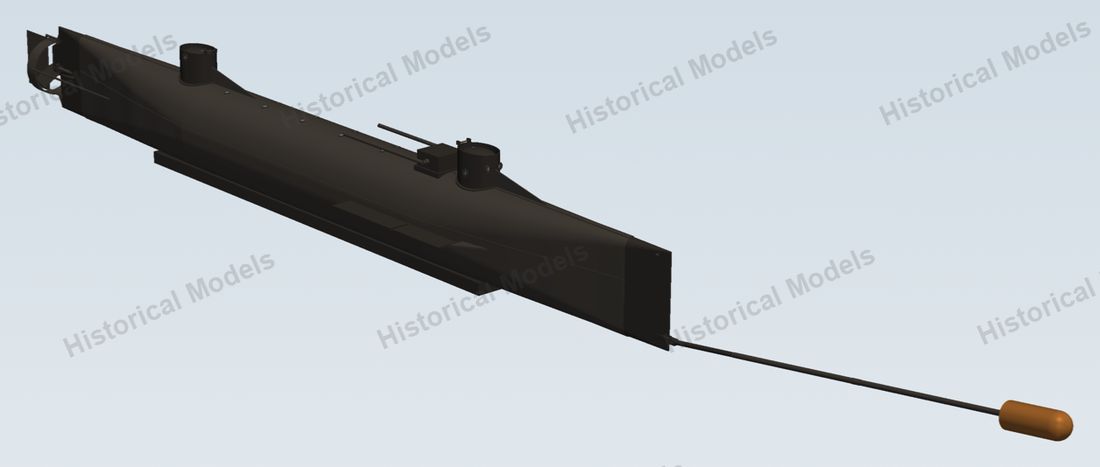
H. L. HunleyConfederate submarine, 1863-64 · model plan at 1:24 and 1:16 · every part in STEP and STL · every part drawn
The first submarine to sink an enemy warship, built part by part from the measurements taken on the real boat after she was raised in 2000.
180 files, 198 parts, 101 drawing sheets
180 files, 198 parts, 101 drawing sheets
Digital files. Nothing is shipped. No refunds.
Watch her build
Every part of the plan going on one at a time, in the order of the build guide.
Her story
The boat
H. L. Hunley was the third submarine built by a private group: the engineers James McClintock and Baxter Watson, with lawyer and customs official Horace L. Hunley as the main backer. Their first boat, Pioneer, was scuttled at New Orleans in 1862; the second, American Diver, was lost under tow off Mobile without loss of life. The third was built at the Park and Lyons machine shop in Mobile in 1863, with help from army engineers including Lt. William Alexander and Lt. George E. Dixon. On 31 July 1863 she sank a coal flat in the Mobile River with a towed torpedo, and General Beauregard had her sent by rail to Charleston, where she arrived about 12 August 1863.
Two sinkings
On 29 August 1863 she dived with her hatches open at Fort Johnson and five men drowned. Raised and handed to Hunley's own crew, she sank again on 15 October 1863 in a practice dive: Horace Hunley and seven men died. When she was raised the forward sea cock was found open and the keel-weight bolts not turned far enough. She was then refitted with a spar torpedo on an iron spar at the bottom of the bow.
The attack
On the night of 17 February 1864 Lt. Dixon and seven men cranked out from Breach Inlet and struck the sloop USS Housatonic about four miles off Charleston, about 8:45 pm. Housatonic sank within minutes with the loss of five men: the first sinking of an enemy warship by a submarine in combat. Hunley never came home.
Found and raised
The wreck was found on 3 May 1995 by Clive Cussler's NUMA, about 1,000 ft seaward of Housatonic, buried in sand and lying over to starboard. She was raised on 8 August 2000 and taken to the Warren Lasch Conservation Center in North Charleston. The eight crewmen were found at their stations and buried at Magnolia Cemetery on 17 April 2004. Near Dixon lay his 1860 $20 gold coin, bent by a bullet at Shiloh and engraved 'My life Preserver'.
Why she sank
Still not settled. The crew showed no sign of trying to escape and the keel releases were not used, which points to the crew being knocked out, perhaps by the blast of their own charge only about 16 ft away. In 2019 the forward ballast intake pipe was found broken loose, another possible cause. Being rammed and being dragged down by her anchor have been ruled out.
Built from the parts

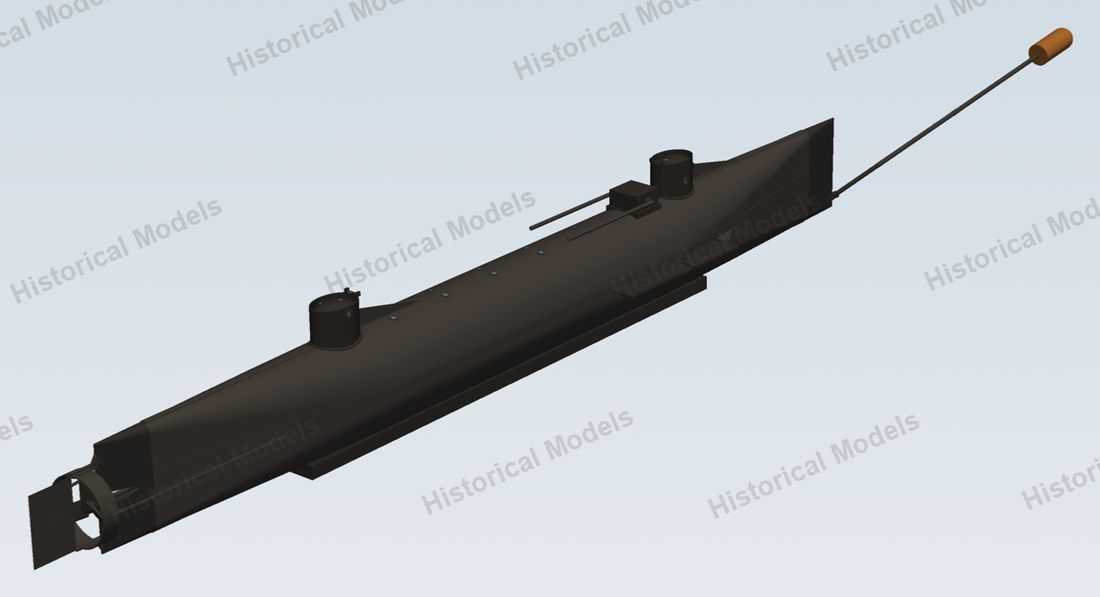
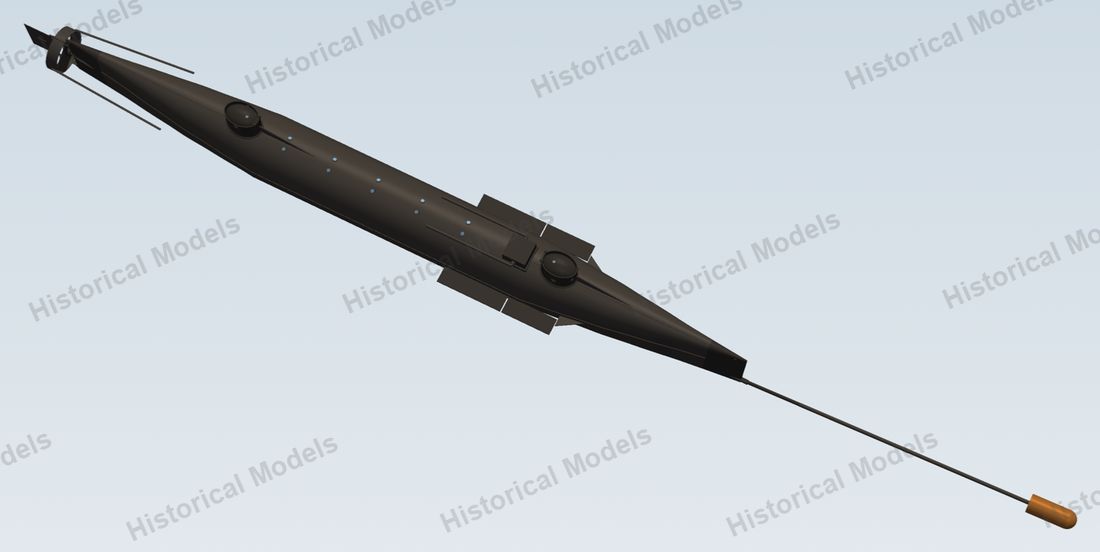
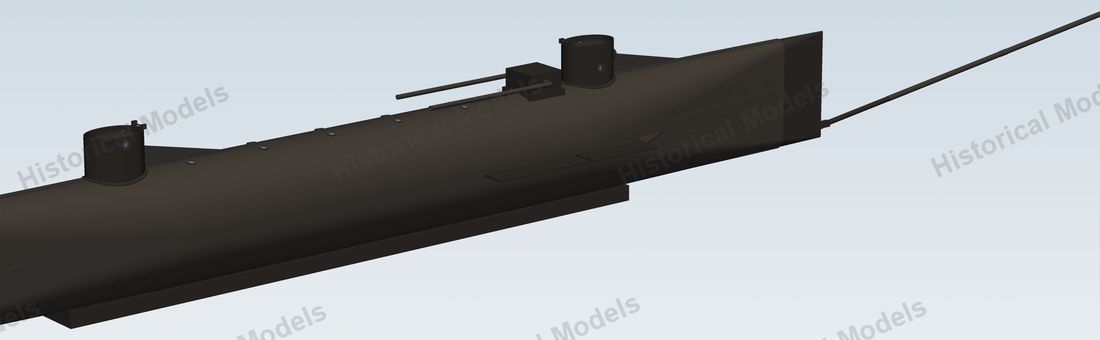

Computer pictures of the boat put together from nothing but the plan's own part files, each in its place.
Finished size
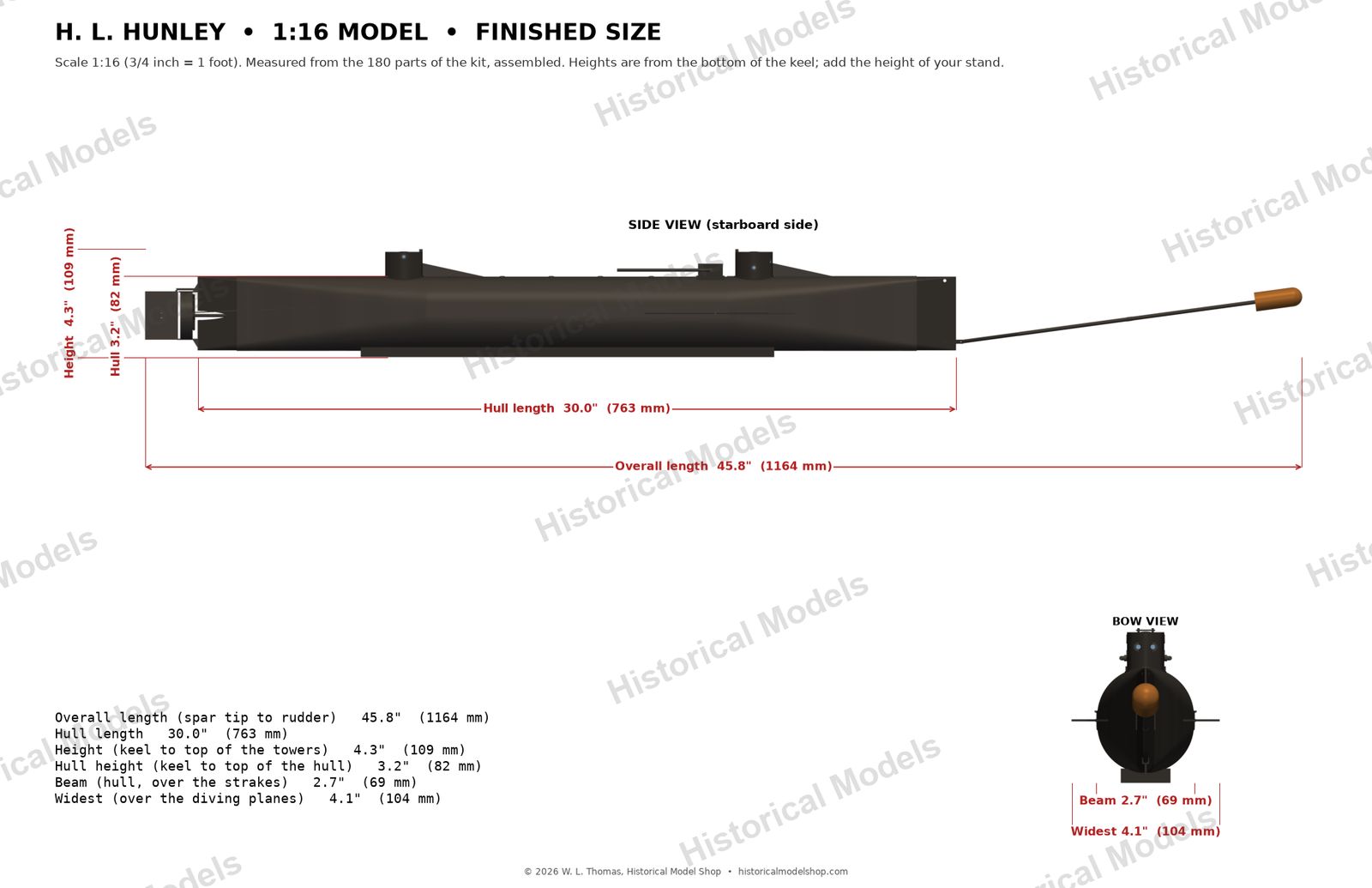
1:24 (1/2 inch = 1 foot)
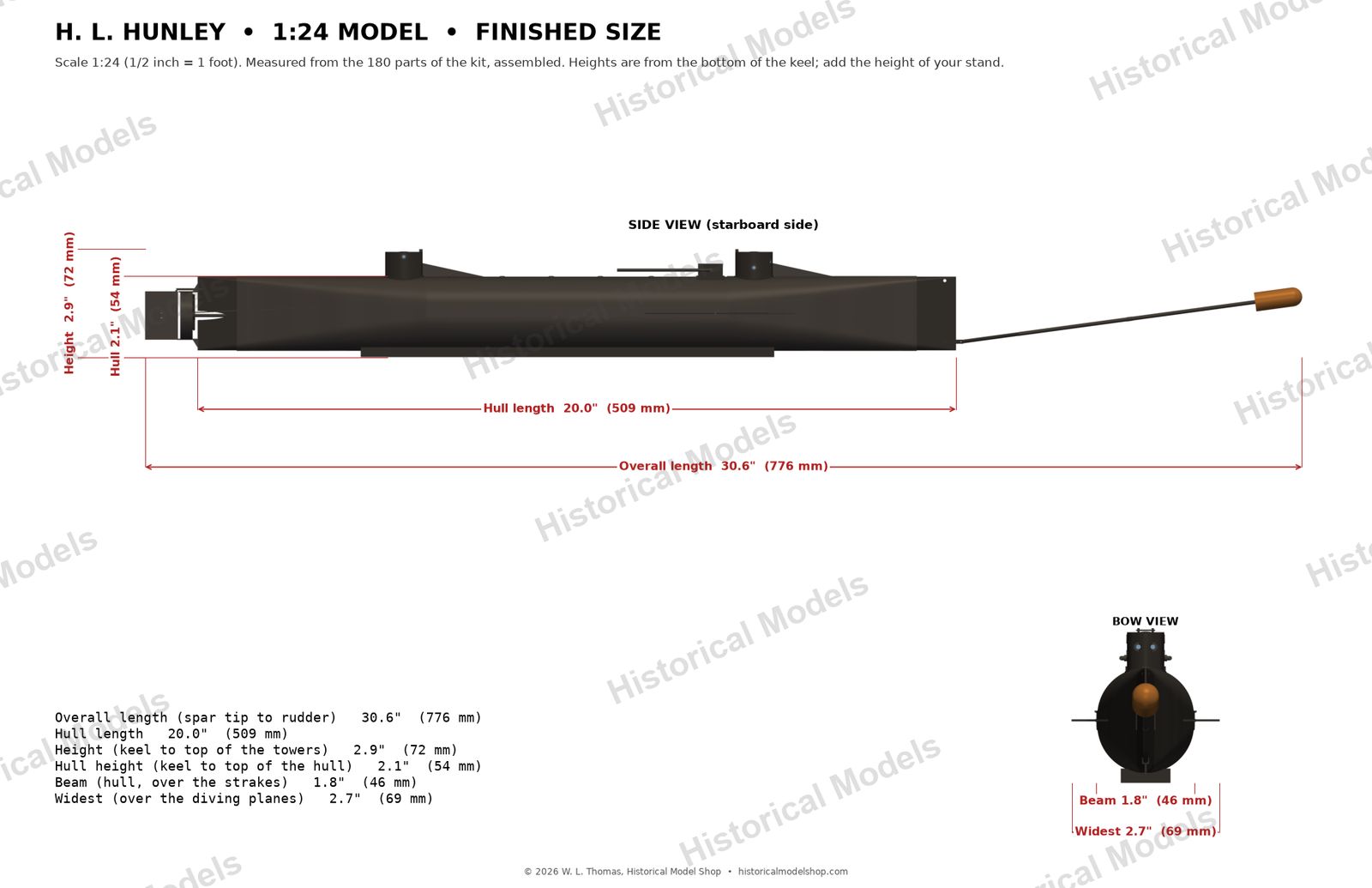
1:16 (3/4 inch = 1 foot)
What is in each plan
- Every part as a STEP file (inches) and as an STL file (millimetres), at model size and each in its exact place: open them together and the boat assembles itself. Ready for PrusaSlicer, Bambu Studio, OrcaSlicer or Cura, or for CAD and CNC.
- Drawing sheets (PDF, letter size), one for each different part, with a 1-inch check square, and the parts book with every sheet in one PDF.
- The build guide: her story, then the boat in stages, each with a picture of the model so far.
- The size drawing with every measurement.
Where the plan comes from
This plan is built from the measurements taken on the real boat after she was raised in 2000, published by the U.S. Navy in 'H. L. Hunley Recovery Operations' (Naval History and Heritage Command, 2016, eds. Neyland and Brown), and from its scaled Plate Plan by Michael Scafuri (Warren Lasch Conservation Center, courtesy of the Friends of the Hunley): hull length 40 ft 0 3/4 in, width 3 ft 7 1/2 in, height 4 ft 3 in with the keel, the plate courses, castings, towers, snorkel box, planes, propeller, shroud, rudder, keel blocks and spar.
Parts whose sizes have not been published are RECONSTRUCTED from their descriptions and say so on their sheets: most of the interior (crank, flywheel, gears, brackets, pumps, piping, bench, seat, shelf, gauge, lantern), the steering arm outside the hull, the torpedo, and some small fittings. The bow boom, the reel and the spar's rigging lines, known only from an 1863 painting, are not included. No paint was found on the hull: she is shown as bare dark iron.
You may not sell, share or distribute the plan or its files, but you are welcome to build this boat, as many as you like, and to sell the models you build. These are digital files and, as such, there are no refunds.
Building the history of America is what this project is for. Enjoy!
— W. L. Thomas, Historical Model Shop, historicalmodelshop.com